### Quick Answer
> GTA 6 will run on 16GB RAM for low-to-medium settings at 1080p, but 32GB RAM is mandatory for stable 60 FPS at 1440p and 4K Ultra settings. High-density asset streaming across Leonida causes severe frame-time stutters on systems restricted to 16GB.
| Hardware Tier | Target Resolution & FPS | Recommended RAM | Target VRAM | Benchmark Processor | Benchmark Graphics Card |
| :--- | :--- | :--- | :--- | :--- | :--- |
| **Minimum Specs** | 1080p @ 30 FPS (Low Settings) | 16 GB DDR4 (Dual-Channel) | 8 GB GDDR6 | Intel Core i5-11400 / AMD Ryzen 5 3600 | Nvidia RTX 2060 Super / AMD RX 5700 XT |
| **Recommended Specs** | 1080p/1440p @ 60 FPS (Medium-High) | 32 GB DDR4 / DDR5 | 12 GB GDDR6X | Intel Core i7-13700K / AMD Ryzen 7 7700X | Nvidia RTX 4070 / AMD RX 7800 XT |
| **Enthusiast / 4K Max** | 4K @ 60+ FPS (Ultra / Ray Tracing) | 32 GB – 48 GB DDR5 | 16 GB+ GDDR6X | Intel Core i9-14900K / AMD Ryzen 7 7800X3D | Nvidia RTX 4080 Super / RTX 4090 |
| **Extreme Frame Rate** | 1440p/4K @ 120+ FPS (High Refresh) | 64 GB DDR5 (6000MHz CL30) | 24 GB GDDR6X | AMD Ryzen 9 7950X3D / Intel i9-14900KS | Nvidia RTX 4090 |
1. **System Memory Allocation**: RAGE 9 pre-allocates up to 14GB of system RAM for global entity states, traffic logic, and physical collision mesh tables before loading active graphics assets.
2. **Texture Decompression**: DirectStorage 1.2 routes compressed textures from PCIe 4.0 NVMe drives directly through system RAM staging buffers into VRAM, placing heavy IO strain on memory bandwidth.
3. **Dynamic Pool Swapping**: The engine constantly unloads and loads zone data between Vice City metro districts, Hamlet, and Kelly County, creating system memory spikes during high-speed vehicular travel.
4. **Frame-Time Stabilization**: Dual-channel 32GB configurations eliminate micro-stutters and frame-time spikes by keeping background operating system processes isolated from the main rendering loop.
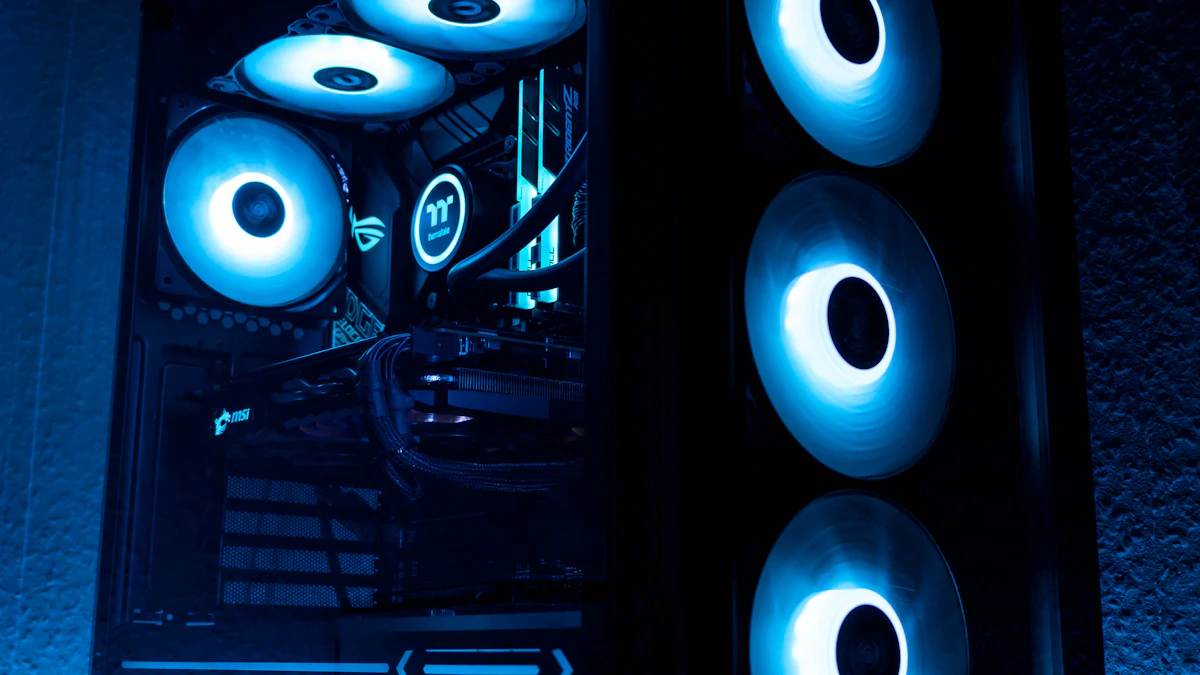
*Modern PC hardware requiring massive system memory bandwidth to process high-resolution assets in next-gen gaming engines.*
---
## The Memory Wall: Why 16GB RAM Will Struggle in Leonida
PC gaming hardware standards shift abruptly with the arrival of a new Rockstar Games title. For over a decade, 16GB of system memory stood as the undisputed sweet spot for gaming PCs across North America and Europe. Modern titles are breaking that boundary, and the upcoming release of Grand Theft Auto 6 will officially make 32GB RAM the baseline requirement for smooth, high-fidelity gameplay.
The console architecture of the PlayStation 5 and Xbox Series X utilizes 16GB of unified GDDR6 memory. This memory pool is shared dynamically between the central processor (CPU) and graphics processor (GPU). PCs do not possess a unified memory layout. System memory (DDR4 or DDR5) handles the operating system, background applications, game logic, structural physics, AI routing, and audio processing. The dedicated video memory (VRAM) on your graphics card handles textures, geometry buffers, shadow maps, and ray-tracing acceleration structures.
Because Windows 11 regularly consumes between 3.5GB and 5.5GB of RAM just operating idle background tasks, a PC equipped with 16GB of total RAM leaves only 10.5GB to 12.5GB for the active game executable. When RAGE 9 (Rockstar Advanced Game Engine) attempts to load the massive state of Leonida, system RAM utilization instantly hits that ceiling.
When game memory requirements exceed available physical RAM, Windows activates the system pagefile—allocating virtual memory space on your storage drive. Even the fastest Gen4 NVMe SSDs operating at 7,000 MB/s transfer rates operate at a fraction of the bandwidth delivered by DDR5 system memory (which routinely pushes over 50,000 MB/s to 80,000 MB/s). The instant RAGE 9 swaps game data into the storage pagefile, your system suffers severe frame-time drops, audio desynchronization, and visible pop-in across long draw distances.
Understanding these hardware bottlenecks is vital when reviewing the extended PC timeline. To analyze why PC gamers face a delayed launch window compared to console players, read our breakdown on
why GTA 6 is delayed on PC and Take-Two's platform strategy.
---
## System Memory vs. Video Memory: The VRAM Spillover Problem
The single largest driver of system RAM usage in modern PC games is dedicated video memory (VRAM) overflow. Graphics card manufacturers continue selling mid-range cards configured with only 8GB or 12GB of VRAM. Titles utilizing high-resolution 4K textures, volumetric lighting models, and hardware-accelerated ray tracing saturate an 8GB VRAM buffer almost immediately.
```
+-------------------------------------------------------------------+
| SYSTEM RAM (32 GB) |
| +-------------------+ +-------------------+ +---------------+ |
| | Windows 11 OS | | GTA 6 Engine Core | | VRAM Overflow | |
| | (4.5 GB Alloc) | | (14.2 GB Alloc) | | Buffer (6 GB) | |
| +-------------------+ +-------------------+ +---------------+ |
+-------------------------------------------------------------------+
|
DirectStorage 1.2 Pipeline & PCIe Gen4 Channel
|
+-------------------------------------------------------------------+
| VRAM (12 GB GPU) |
| +-------------------------------------------------------------+ |
| | Active Render Targets / Ray Tracing Maps / Frame Buffers | |
| +-------------------------------------------------------------+ |
+-------------------------------------------------------------------+
```
When graphics memory capacity fills completely, the DirectX 12 Ultimate graphics API does not crash the application. Instead, it implements a fallback procedure known as resource eviction, transferring low-priority assets directly out of GPU VRAM into system RAM.
If your PC features 32GB of DDR4 or DDR5 system memory, your computer easily absorbs this VRAM overflow buffer without collapsing your rendering pipeline. A computer constrained to 16GB of system RAM running an 8GB or 12GB graphics card faces catastrophic bottlenecks.
```
[VRAM Exceeded (8GB Limit)] ➔ [Overflow Pushed to System RAM] ➔ [16GB System RAM Exhausted] ➔ [Pagefile Swap to SSD] ➔ [Massive Stutter / Micro-Freeze]
```
This structural bottleneck results in severe 1% low frame-rate drops. While your average frame-rate counter might display a smooth 60 FPS while standing still in Vice Beach, turning your camera rapidly or driving down Ocean Drive forces the engine to stream new geometry assets simultaneously. If system memory is locked at capacity, your frame rates will plunge down to 15-20 FPS for multiple seconds while the system clears memory addresses.
>
[ROOKIE MISTAKE TO AVOID]: Buying an 8GB VRAM graphics card in 2025 under the assumption that lowering texture settings will save you. Lowering texture quality only reduces graphics memory allocation—it does not lower the engine's underlying system RAM CPU draw-call allocations for NPC logic, vehicle traffic density, or dynamic world physics.
---
## Texture Streaming, DirectStorage 1.2, and Storage Bottlenecks
The Leonida map introduces unprecedented world complexity. Rockstar Games has constructed a continuous game space that seamlessly connects the sprawling urban grid of Vice City through the marshlands of the Grassriver down to the island chain of the Vice Keys. Processing this scale of world rendering without mid-game loading screens requires aggressive background texture streaming.

*Densely populated urban environments in Leonida demand instantaneous memory swapping to prevent visual pop-in.*
RAGE 9 relies heavily on Microsoft DirectStorage 1.2 API integration. DirectStorage bypasses traditional CPU-bound decompression pathways, streaming compressed game assets directly from an NVMe SSD into GPU memory. DirectStorage requires substantial system RAM reserved as temporary decompression staging buffers:
- **Bypass CPU Bottlenecks**: Decompression calculations shift directly to GPU compute units or dedicated system memory threads.
- **RAM Staging Reserve**: The game reserves a continuous 2GB to 4GB system memory space specifically for incoming IO asset blocks.
- **IO Throughput**: Sequential read speeds above 5,000 MB/s require high-frequency RAM to process incoming memory descriptors without bottlenecking the storage controller.
For an in-depth operational analysis of installation size footprint and drive performance requirements, read our detailed report covering the
GTA 6 estimated 300GB download size and NVMe SSD recommendations.
If system RAM availability drops below operational parameters during asset streaming, the DirectStorage pipeline drops back to legacy Win32 file IO mode. Legacy mode routes raw data blocks through your CPU sockets first, saturating your processor core threads, spiking CPU temperatures, and generating extreme frame latency variations.
---
## Dense Crowds, NPC AI Memory Pools, and Interior Instancing
Grand Theft Auto titles separate themselves from conventional open-world games through spatial agency and dynamic simulation density. Leaked development data and official promotional materials demonstrate that Leonida features the most complex crowd simulation system ever designed for interactive entertainment.
Every active NPC across Vice City features individual pathfinding routines, behavioral states, clothing asset variations, and memory arrays tracking player interactions.
```
+---------------------------------------+
| RAGE 9 AI & WORLD STATE SIM |
+---------------------------------------+
|
+-----------------------------------+-----------------------------------+
| | |
+-----------------------------------+ +-----------------------------------+ +-----------------------------------+
| Pedestrian Logic | | Traffic Systems | | Environmental Dynamics |
| - Real-time pathfinding routing | | - High-speed vehicle physics | | - Dynamic water surface meshes |
| - Dynamic behavioral states | | - Mechanical deformation grid | | - Real-time wind/volumetric fog |
| - Unique mesh variations | | - Individual passenger AI | | - Breakable world props |
+-----------------------------------+ +-----------------------------------+ +-----------------------------------+
| | |
+-----------------------------------+-----------------------------------+
|
+---------------------------------------+
| System RAM Buffer Allocation (14GB+) |
+---------------------------------------+
```
When you enter dense locations—such as Starfish Island shopping districts, Ocean Drive nightclubs, or public beach stretches—the engine maintains hundreds of distinct entities in memory simultaneously. The physical collision mesh data, ragdoll parameters, and spatial positional data for these entities must live inside system RAM for zero-latency CPU evaluation.
Furthermore, dynamic interior architecture places immense pressure on physical hardware buffers. Unlike older open-world engines that rely on loading screens or spatial fading to render interior buildings, GTA 6 utilizes continuous spatial instancing. For a comprehensive look at how seamless world design affects hardware performance, review our analysis on
enterable buildings and interior map density in GTA 6.
```
[Outdoor City District Rendering]
|
(Seamless Transition / Zero Loading Screen)
|
+-------------------------------------------------------+
| System RAM Holds Dual Spatial Matrices Simultaneously |
| 1. Full Outdoor Map Mesh & Traffic Simulation |
| 2. Interior High-Poly Lighting & Prop Arrays |
+-------------------------------------------------------+
```
Because system memory must process both spatial matrices simultaneously to prevent visual loading delays upon entering buildings, running 16GB of system RAM forces the game engine to violently clear outdoor memory buffers. Returning outside after visiting an indoor space results in missing vehicle traffic models, floating textures, and delayed world geometry rendering.
>
[PRO-GAMER TACTICAL HACK]: If forced to run GTA 6 on a 16GB RAM system at launch, open Windows Task Manager, navigate to the Details tab, set the priority of `GTA6.exe` to "High," and disable non-essential background services like Discord overlays, Chrome background instances, and RGB lighting management software (such as iCUE or Razer Synapse). This action can reclaim up to 2.5GB of crucial system memory for your frame-rendering budget.
---
## Console Parity Analysis: PS5, PS5 Pro, and PC Hardware Specs
To determine real-world system memory targets for PC, we must benchmark our performance projections directly against target console hardware configurations.

*High refresh rate PC setups require elevated system memory headroom to maintain stable frame timing.*
The base PlayStation 5 and Xbox Series X consoles operate on a unified 16GB GDDR6 memory layout on a 256-bit bus structure. The console operating systems permanently reserve roughly 2.5GB to 3GB of that unified memory for dashboard features, game suspend functions, and background capture rendering. This leaves game developers with roughly 12.5GB to 13.5GB of total memory space allocated dynamically between systemic graphics assets and game logic execution.
The PlayStation 5 Pro elevates this memory performance ceiling significantly:
```
+------------------------+--------------------------+----------------------------+
| Hardware Spec Metric | Base PlayStation 5 | PlayStation 5 Pro |
+------------------------+--------------------------+----------------------------+
| System Memory | 16 GB Unified GDDR6 | 16 GB Unified GDDR6 |
| Custom RAM Allocation | 0 GB Additional DDR5 | +2 GB High-Speed DDR5 |
| Memory Bandwidth | 448 GB/s | 576 GB/s (+28% Increase) |
| Dev Memory Available | ~12.5 GB | ~14.5 GB (Dedicated Pool) |
+------------------------+--------------------------+----------------------------+
```
By adding 2GB of lower-speed DDR5 memory reserved strictly for OS operations, Sony freed up an extra 2GB of high-speed unified GDDR6 memory exclusively for game developers. The PS5 Pro also features a 28% increase in memory bandwidth (boosting speeds from 448 GB/s up to 576 GB/s).
This enhanced hardware capability allows console engines to run enhanced ray-tracing features and higher-resolution texture buffers. To understand how console hardware configurations set overall industry baseline targets, check our technical guide on
GTA 6 frame-rate caps across PS5, Xbox Series X, and PS5 Pro.
For a PC to match or exceed the frame rates achieved by the PS5 Pro, it must compensate for Windows system overhead. Because a PC cannot execute console-level low-level hardware optimizations, it requires roughly 1.5x to 2x the memory capacity of console hardware to guarantee equivalent performance stability.
$$\text{Required PC System Memory} = (\text{Console Target Memory} \times 1.5) + \text{Windows OS Overhead}$$
$$\text{Required PC System Memory} = (13.5\text{ GB} \times 1.5) + 4.5\text{ GB} \approx 24.75\text{ GB}$$
This real-world calculation proves why a 16GB system setup falls short, confirming 32GB system RAM as the mandatory threshold for high-performance PC hardware targets.
---
## Upgrade Strategy: DDR4 vs DDR5 Specs, Latency, and Budget Hardware Recommendations
Upgrading your system to 32GB of memory requires evaluating your underlying motherboard chipset, socket type, memory speed ratings, and sub-timing configurations.

*Proper memory channel routing and optimized XMP/EXPO profiles eliminate processing delays in modern gaming battlestations.*
### DDR4 vs DDR5 Performance Considerations
If your current PC relies on an older socket layout (such as Intel LGA 1200 or AMD AM4), upgrading your RAM means acquiring DDR4 modules. If you are operating on modern sockets (Intel LGA 1700 / LGA 1851 or AMD AM5), upgrading to dual-channel DDR5 memory provides massive bandwidth advantages for modern asset streaming workloads.
```
+-------------------------+-------------------------------+-------------------------------+
| Memory Parameter | DDR4 Benchmark Spec | DDR5 Benchmark Spec |
+-------------------------+-------------------------------+-------------------------------+
| Target Speed (MT/s) | 3200 MHz - 3600 MHz | 6000 MHz - 6400 MHz |
| CAS Latency (CL Timing) | CL16 - CL18 | CL30 - CL36 |
| Peak System Bandwidth | ~25.6 GB/s - 28.8 GB/s | ~48.0 GB/s - 51.2 GB/s |
| Voltage Requirements | 1.35V | 1.35V - 1.40V |
| On-Die ECC Support | No | Yes (Standard Integrated) |
+-------------------------+-------------------------------+-------------------------------+
```
While DDR5 features higher CAS latency ratings than DDR4 (CL30 versus CL16), its massive raw data throughput completely eclipses older memory standards. RAGE 9 relies heavily on raw bandwidth throughput to transfer heavy environmental textures from host RAM into VRAM, making high-frequency DDR5 memory configurations exceptionally effective.
### Memory Configurations: Dual-Channel vs Quad-Channel Realities
When installing upgraded 32GB memory configurations, physical placement within your motherboard slots is critical for performance:
- **Dual-Channel Routing (2x16GB)**: Always install two 16GB memory sticks into motherboard slots A2 and B2 (typically slots 2 and 4 counting rightward from CPU socket). Dual-channel mode doubles operational memory bus width from 64-bit to 128-bit.
- **Avoid Single Channel (1x32GB)**: Running a single 32GB memory module reduces memory transfer bandwidth by 50%, introducing severe micro-stuttering during open-world asset streaming.
- **4-Stick Bottlenecks (4x8GB or 4x16GB on DDR5)**: Running four physical sticks on modern DDR5 motherboards taxes your CPU's integrated memory controller (IMC). This forces the system motherboard to drop memory clock speeds from 6000MHz down to 4800MHz or lower to preserve system stability.
### Western Retail Upgrade Buying Guide (US & UK Pricing)
For players building or upgrading system hardware in preparation for launch, these current dual-channel 32GB RAM configurations deliver optimal price-to-performance value across major US and UK hardware retailers (including Micro Center, Best Buy, Target, Amazon US, Currys, GAME UK, and Amazon UK):
- **Budget DDR4 Upgrade (AM4 / LGA 1200 Systems)**:
* *Corsair Vengeance LPX 32GB (2x16GB) DDR4 3600MHz CL18*
* **Retail Price**: ~$69.99 USD / £64.99 GBP